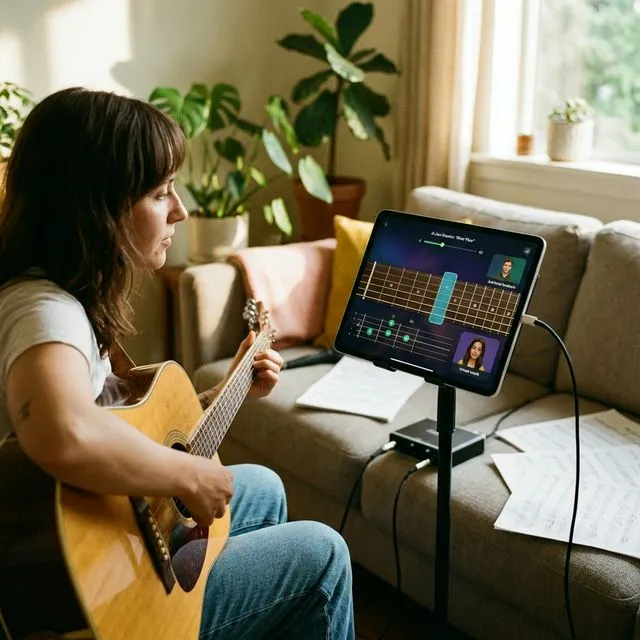
5 Ways AI Is Changing How Musicians Practice
From stem separation to automatic transcription, AI tools are transforming how musicians learn songs and prepare for performances. Here are the five biggest shifts.
AI Is Already in Your Practice Room
Artificial intelligence in music is not some far-off future. It is here now, and working musicians are already using it to learn faster, practice smarter, and prepare more thoroughly for performances.
These are not gimmicks. These are practical tools that solve real problems musicians face every day.
1. Stem Separation
The old way: You wanted to hear just the bass line in a song, so you EQ’d out the highs and hoped for the best. Or you searched YouTube for an isolated track that probably did not exist.
The AI way: Upload any recording and an AI model separates it into vocals, drums, bass, and other instruments. Want to practice the guitar part without the guitar? Mute that stem and play along with the rest of the band.
This is arguably the single most useful AI tool for gigging musicians. It turns any recording into a practice tool. Drummers can play along to songs without the drum track. Vocalists can practice harmonies with just the instrumental. Bass players can hear exactly what the bass is doing without it being buried in the mix.
2. Automatic Key and BPM Detection
The old way: You sat at a piano trying to find the root note, or you tapped along to the beat and did math in your head.
The AI way: Upload a track and the key and tempo are detected in seconds. No guesswork, no manual counting.
This sounds simple, but it eliminates a surprising amount of friction. When you are adding a new song to your repertoire, knowing the key and BPM immediately lets you start learning the actual parts instead of spending time on reconnaissance.
3. Lyrics Extraction from Audio
The old way: You searched the internet for lyrics and hoped they matched the version you were learning. Half the time they were wrong, incomplete, or for a different arrangement.
The AI way: AI speech recognition extracts lyrics directly from the recording you are actually learning. The words match exactly what is being sung, because they come from the same audio.
Some tools — including Gig Friend — also extract timing information, so lyrics can be displayed in sync with playback. This is invaluable for learning vocal timing, phrasing, and where exactly to come in after an instrumental break.
4. Intelligent Practice Recommendations
The old way: You practiced whatever felt right, which usually meant playing the parts you already knew and avoiding the sections that needed work.
The AI way: AI-powered practice tools can identify which sections of a song you struggle with and suggest focused drills. Some tools track your playing accuracy over time and adjust recommendations accordingly.
This is still an emerging area, but the principle is sound: deliberate practice — working on specific weaknesses — is far more effective than unfocused repetition. AI can help identify where to focus.
5. Audio-to-Notation Transcription
The old way: You listened to a passage fifty times, pausing and rewinding, trying to figure out the notes. Or you paid someone to transcribe it.
The AI way: AI transcription tools can generate sheet music or tablature from audio recordings. The accuracy varies depending on the complexity of the music, but for straightforward parts — a vocal melody, a bass line, a chord progression — the results are often good enough to use as a starting point.
Even when the transcription is not perfect, it gives you a foundation to work from. Correcting a mostly-right transcription is much faster than starting from scratch.
The Bigger Picture
None of these tools replace the work of practicing. You still need to put in the hours with your instrument. What AI does is remove the overhead that used to eat into your practice time.
Instead of spending thirty minutes figuring out what key a song is in, what the lyrics are, and what the bass line sounds like under the mix, you can have all of that information in minutes and spend the remaining time actually playing.
For gigging musicians who regularly need to learn new material on tight timelines, that efficiency gain is not just nice to have — it is a competitive advantage.
Gig-Friend Team
The Gig-Friend team is dedicated to helping gig economy workers take control of their finances, optimize their workflow, and build sustainable freelance careers.
Related articles
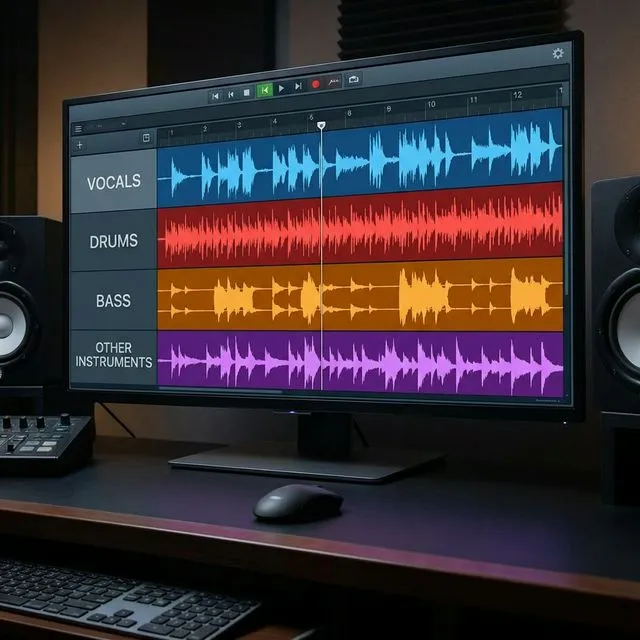
Stem Splitting for Musicians: What It Is and How to Use It
AI-powered stem separation can isolate vocals, drums, bass, and other instruments from any recording. Here is how musicians are using it to learn songs, run better rehearsals, and level up their practice.

What Are Music Stems & How Do Bands Use Them?
A beginner-friendly guide to music stems, how AI has made them accessible to every musician, and the practical ways bands use stems to learn songs, run better rehearsals, and prepare for gigs.

Free Stem Splitter Tools: Are They Worth Your Time?
There are several free stem splitter options for musicians, from open-source AI models to freemium web apps. Here's an honest look at what's actually free, what's good, and where the trade-offs are.